The stories in full

Legends that
come alive in dance

Read the narratives behind Nandini’s performance—from Krishna’s childhood mischief to Andal’s garland, Durga’s courage, and Janabai’s friendship with Vitthala.

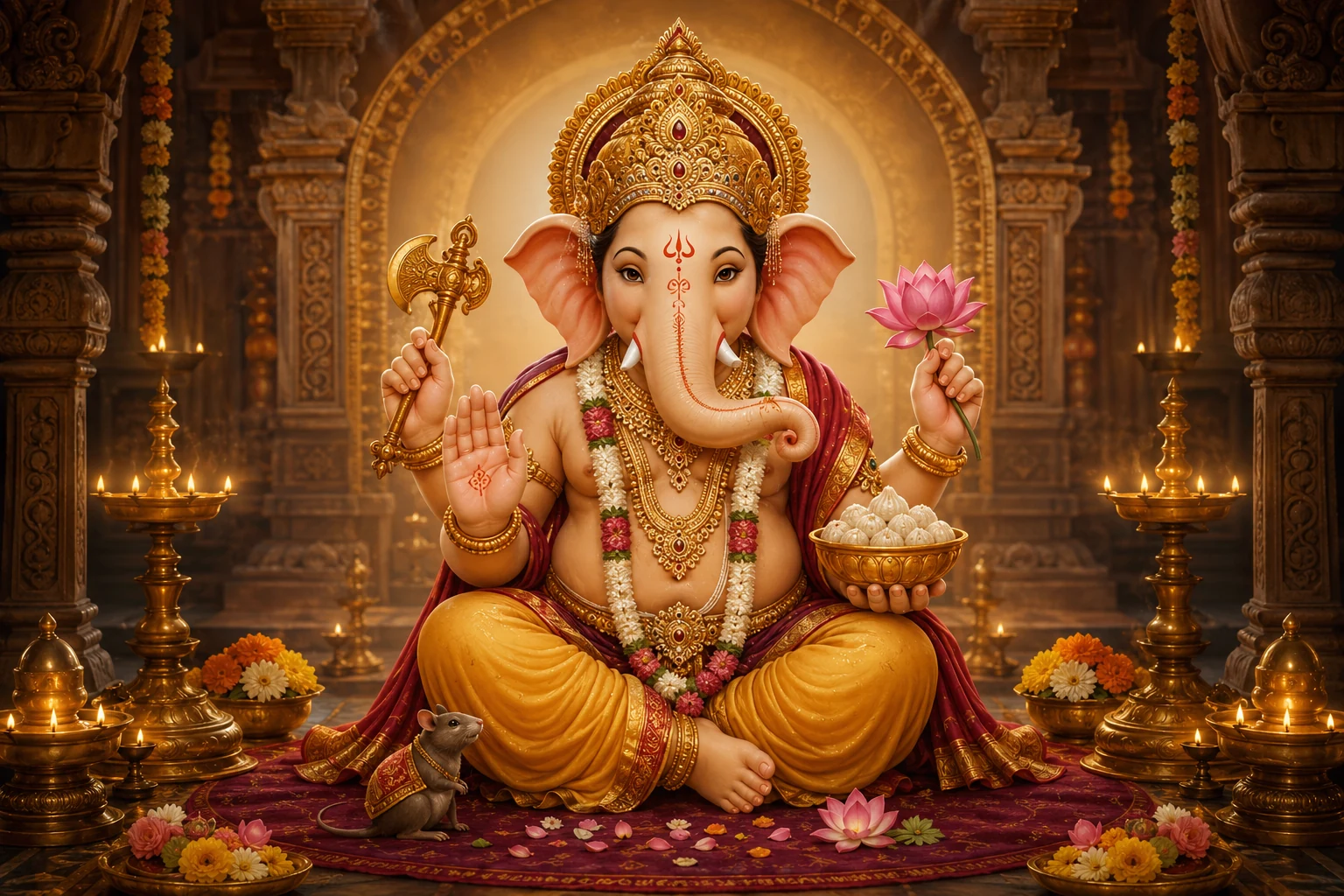
Lord Ganesha seated in blessing amid flowers and traditional brass lamps
01

The first invocation

Ganesha: Why Every Auspicious Beginning Starts With Him

Before the first step is danced and before the first prayer is offered, Ganesha is remembered as the awakener of wisdom and the remover of obstacles.

The story begins with Parvati, who brought a child into being and entrusted him with guarding her doorway. When Shiva returned, the loyal boy refused to let him pass. A fierce encounter followed, and the child lost his head. Seeing Parvati’s grief, Shiva restored him with the head of an elephant and accepted him as his own son.

Shiva then gave Ganesha a special blessing: he would be worshipped first at every pooja and at the beginning of every auspicious undertaking. The elephant head is rich with meaning. Its great size suggests wisdom and knowledge, while the elephant’s ability to move steadily through obstacles represents calm strength and effortless action.

Invoking Ganesha is therefore more than asking an outside power to clear the road. It is a reminder to awaken clarity, awareness, and steadiness within ourselves before beginning. In the Pushpanjali, the offering of flowers welcomes that spirit of humility and auspiciousness onto the stage.
SourcesWhy Lord Ganesha Is Worshipped First — Art of Living
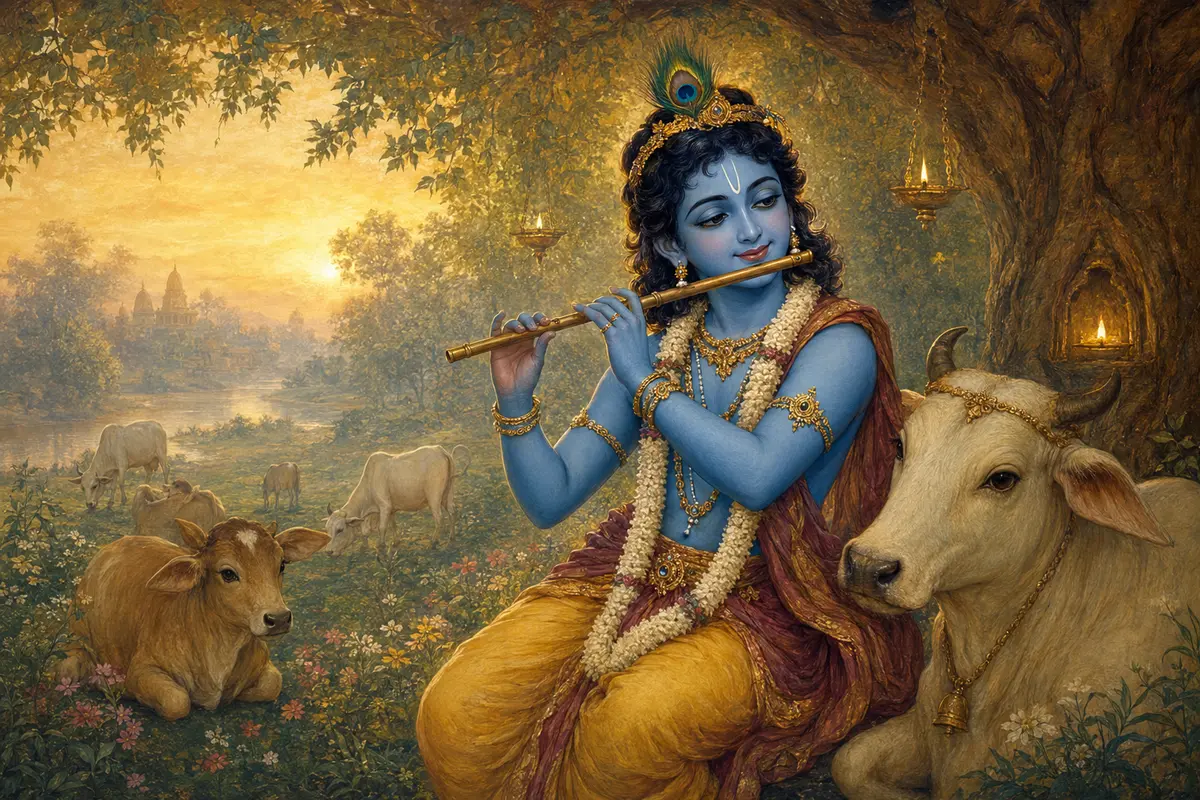
Young Krishna playing his flute among the cows of Vrindavan
02

From Mathura to Gokula

Krishna: The Miraculous Child, Govardhan’s Protector, and the End of Kamsa

Krishna’s story moves from a storm-filled prison night to the laughter of Gokula, the shelter of Govardhan Hill—and finally to the arena where a frightened king’s long reign comes to an end.

The prophecy and the midnight birth

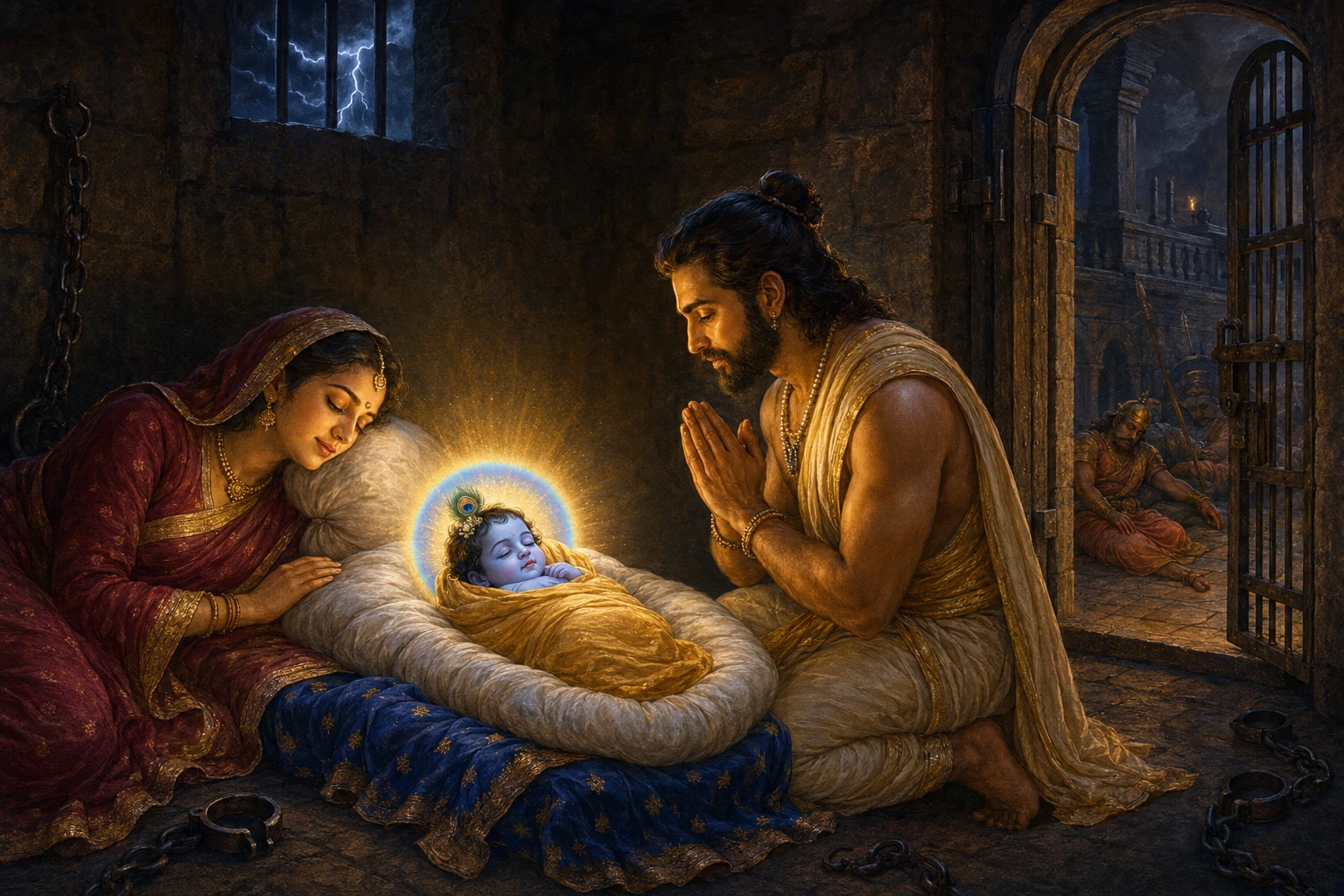
Kamsa, ruler of Mathura, heard a prophecy that the eighth child of his sister Devaki and her husband Vasudeva would bring about his death. Terrified of losing power, he imprisoned the couple and killed their newborn children. When the eighth child was due, Devaki and Vasudeva were placed under even tighter guard. Krishna was born during a night of thunder and heavy rain. At that moment, the guards fell asleep, the prison doors opened, and Vasudeva’s chains came free.

Newborn Krishna radiating divine light beside Devaki and Vasudeva inside Kamsa’s prison

Across the Yamuna to Yashoda

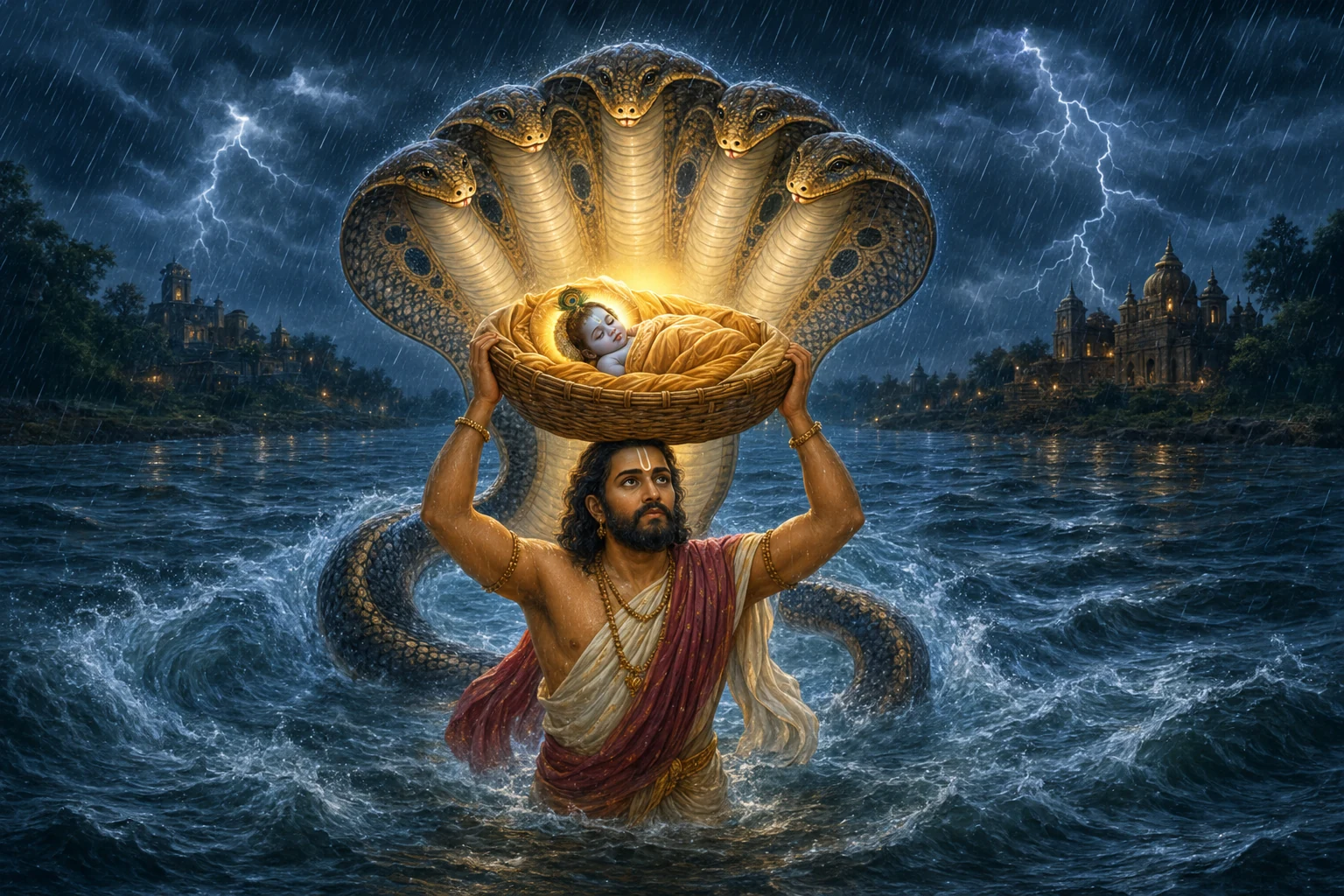
Understanding that the child had to be saved, Vasudeva carried Krishna toward the flooded Yamuna. A safe crossing appeared through the water, allowing him to reach Gokula. There, Nanda’s wife Yashoda had just given birth to a daughter. Vasudeva left Krishna beside the sleeping mother and returned to the prison with the baby girl. When Kamsa tried to harm her, she escaped his grasp and warned him that the child destined to defeat him was already alive elsewhere.

Shesha sheltering newborn Krishna as Vasudeva carries him across the stormy Yamuna River

The butter pranks of Gokula

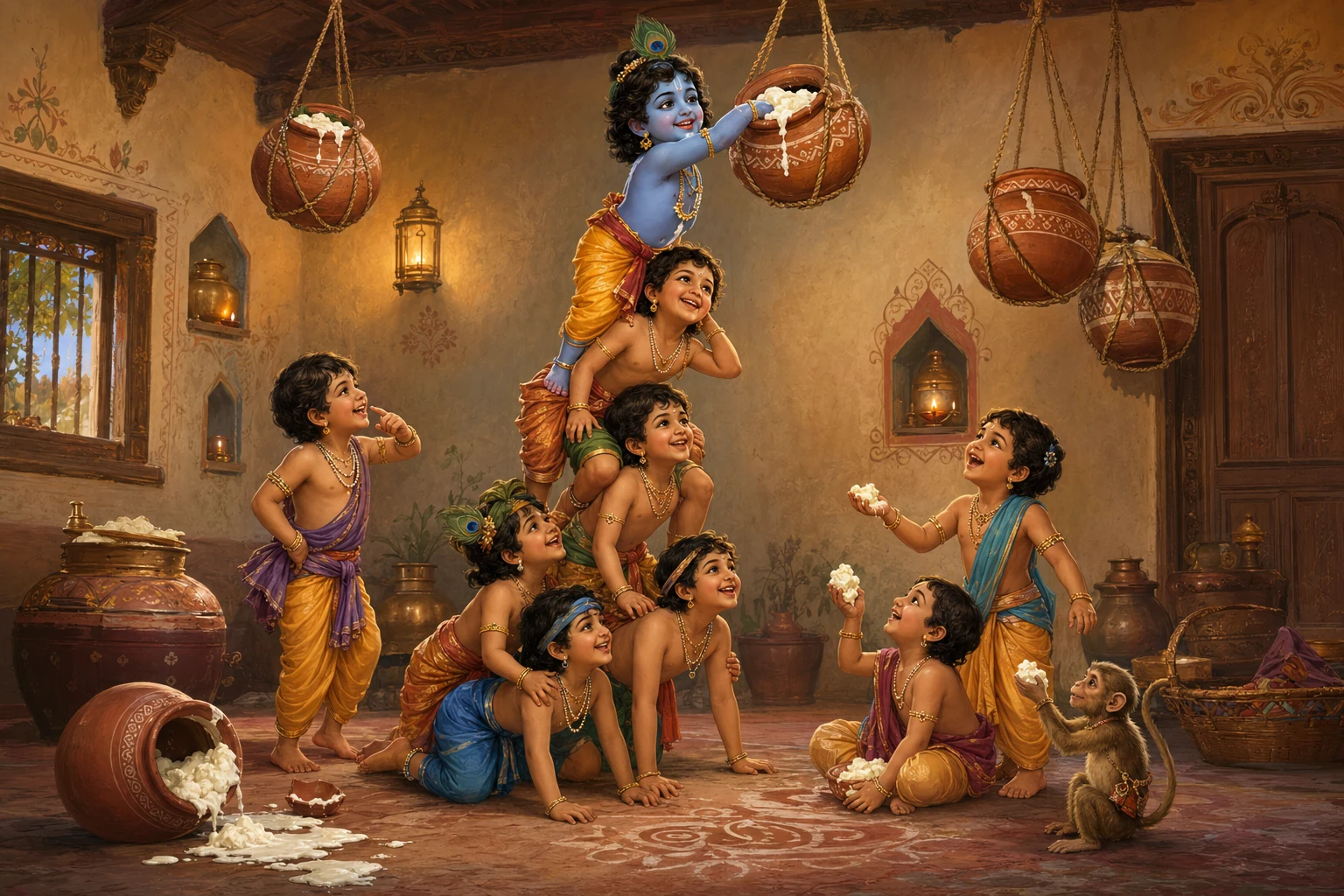
Krishna grew up among the cowherds as Yashoda and Nanda’s beloved son. With his enchanting smile, flute, and dance-like energy, he filled the village with delight. He and his friends slipped into homes, climbed upon one another’s shoulders, and reached the butter pots hung high above them. Sometimes they made a small hole so the butter and curd streamed into their waiting mouths; sometimes the pot came crashing down. Whatever remained was shared with friends and even the monkeys.

Young Krishna and his cowherd friends forming a human pyramid to reach hanging butter pots

Yashoda scolds her lovable thief

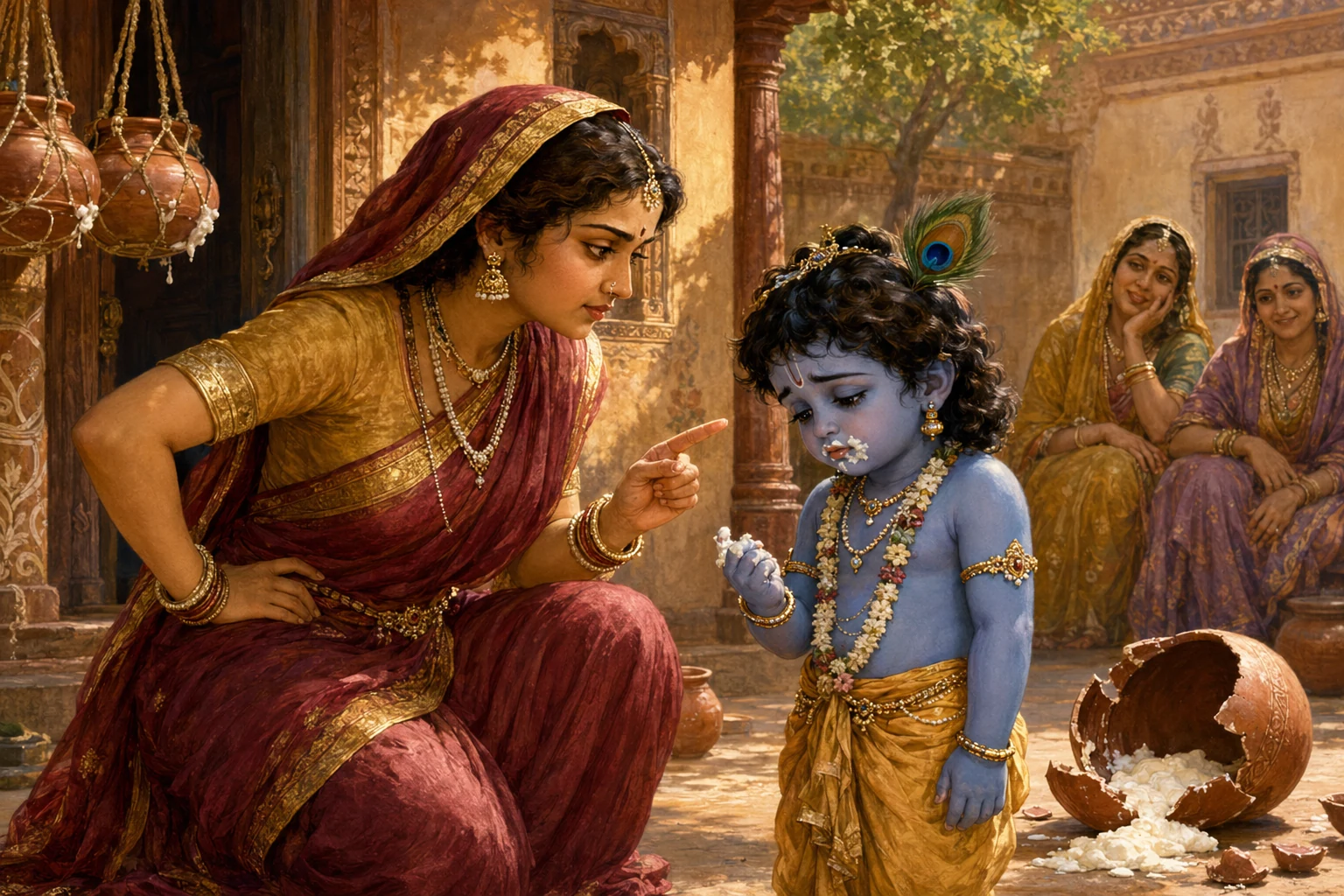
The village women depended on butter and curd for their livelihood, so they repeatedly complained to Yashoda. As Krishna’s pranks became more organized, she tried to scold him and keep him home. Krishna knew exactly how to soften her anger: he would lower his face to the floor and cry until she came to comfort him. Even those who arrived determined to complain found it difficult to remain angry. His mischief disrupted their homes, yet his affection made him the heart of the community.

Yashoda lovingly scolding a downcast young Krishna after a butter prank

Krishna lifts Govardhan Hill

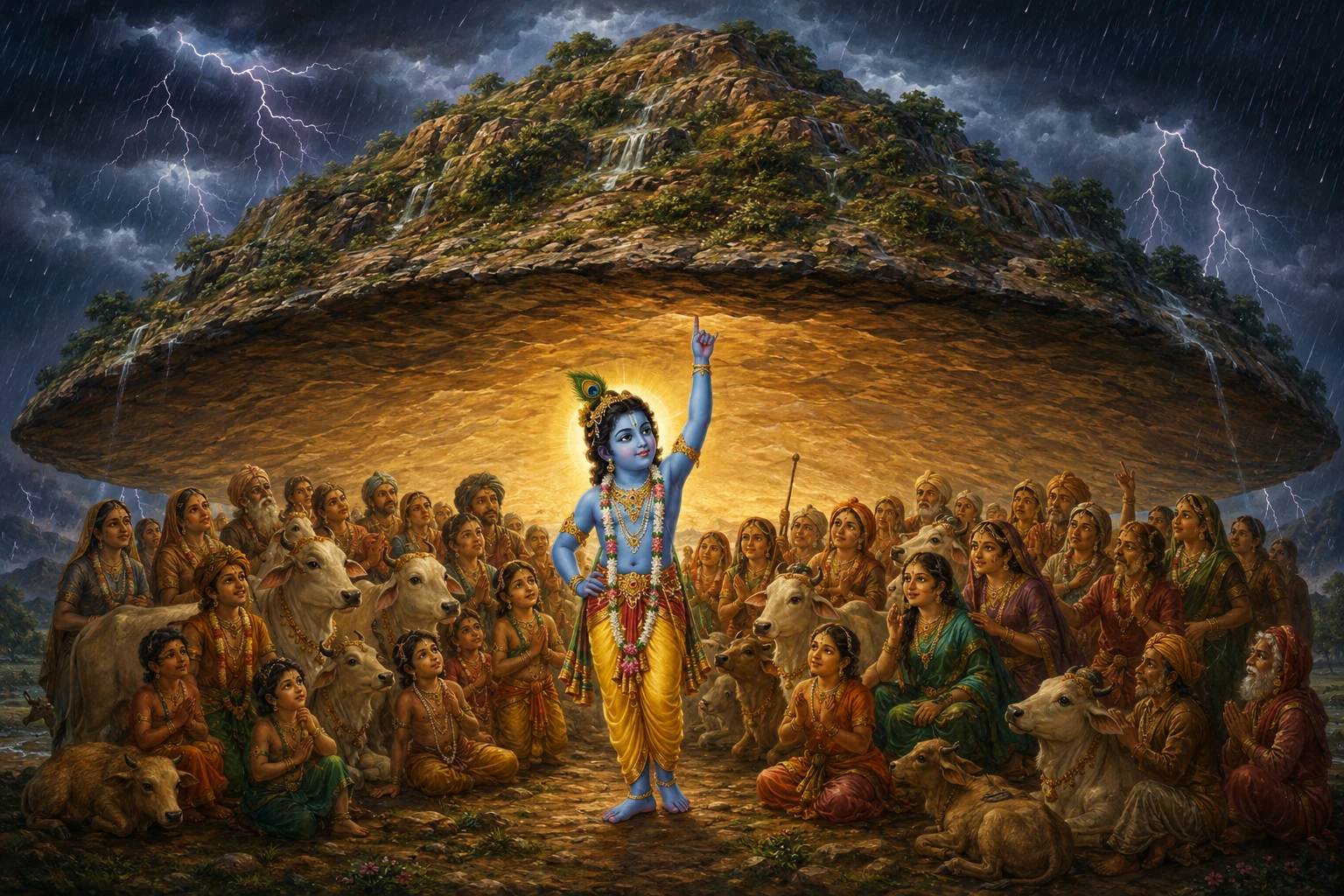
When the people of Braj prepared their annual worship of Indra, the god of rain, the young Krishna encouraged them instead to honor Govardhan Hill, the cows, and the land that directly sustained their lives. Enraged, Indra sent destructive clouds, thunder, and torrential rain toward Vrindavan. As the frightened villagers turned to Krishna, he calmly lifted Govardhan Hill upon the little finger of his raised hand, creating a vast shelter for the cowherd families and their animals. For seven days and seven nights he held the hill aloft until Indra withdrew the storm and came before Krishna in humility. The story remembers Krishna as protector and teaches gratitude toward nature, responsibility in leadership, and the surrender of pride.

Young Krishna lifting Govardhan Hill on his little finger to shelter villagers and cows from a storm

Krishna returns to Mathura

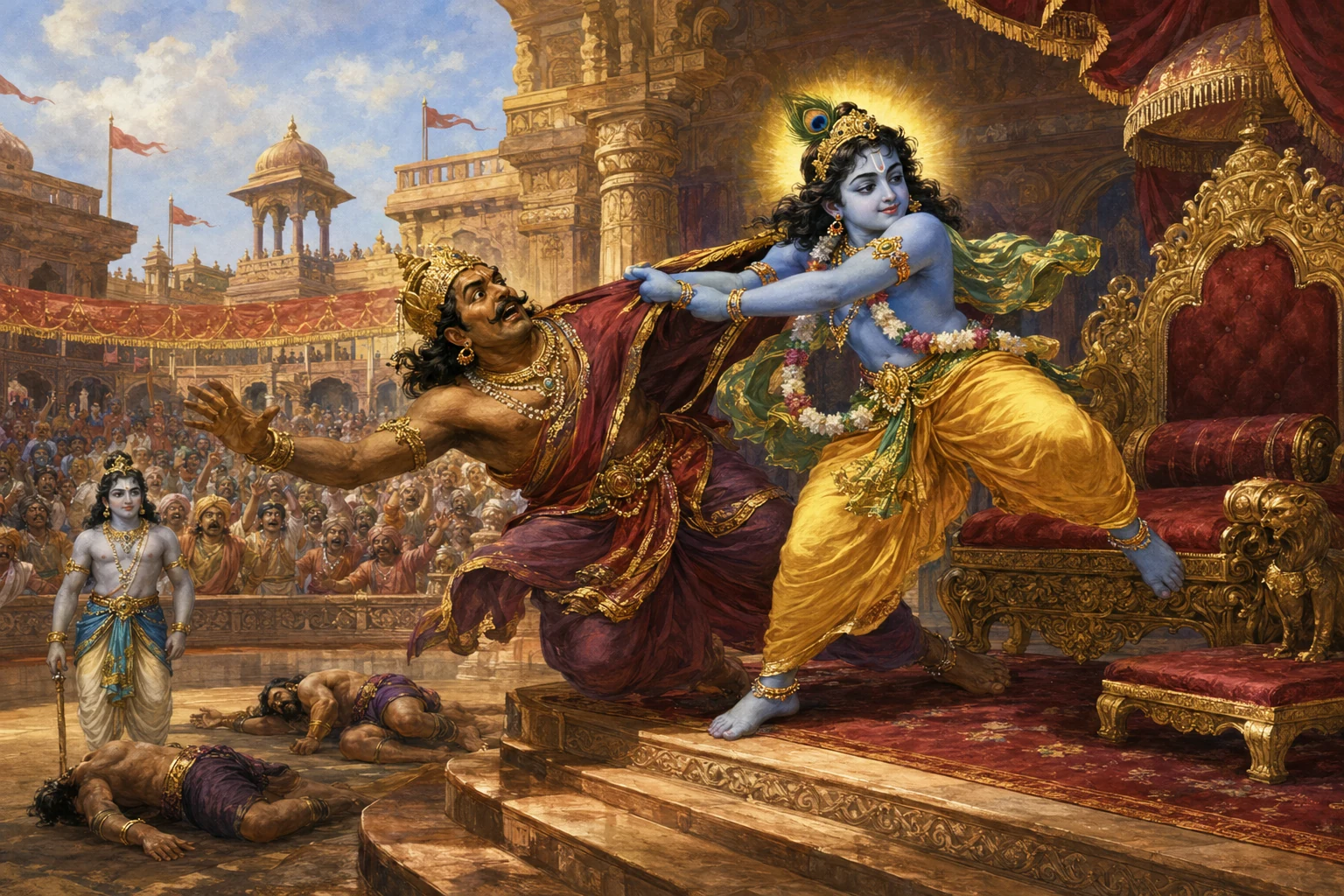
Years later, Kamsa learned that Krishna was Devaki’s eighth child. He arranged a wrestling festival in Mathura as a trap and invited Krishna and Balarama through their uncle Akrura. The brothers entered the city without fear. In the arena they defeated Kamsa’s powerful wrestlers. Enraged, Kamsa ordered them expelled and threatened their family. Krishna leapt to the royal platform, pulled the tyrant from his throne, and killed him, ending the fear that had ruled Mathura. Kamsa’s father Ugrasena was restored, and Devaki and Vasudeva were freed.

Krishna confronting King Kamsa in the royal wrestling arena of Mathura
SourcesThe Birth of Krishna — Isha Butter Pranks: Krishna in Gokula — Isha The Loveable Thief — Isha Krishna Lifting Govardhan Parvat — Dharmic Verses The Killing of Kamsa — Back to Godhead
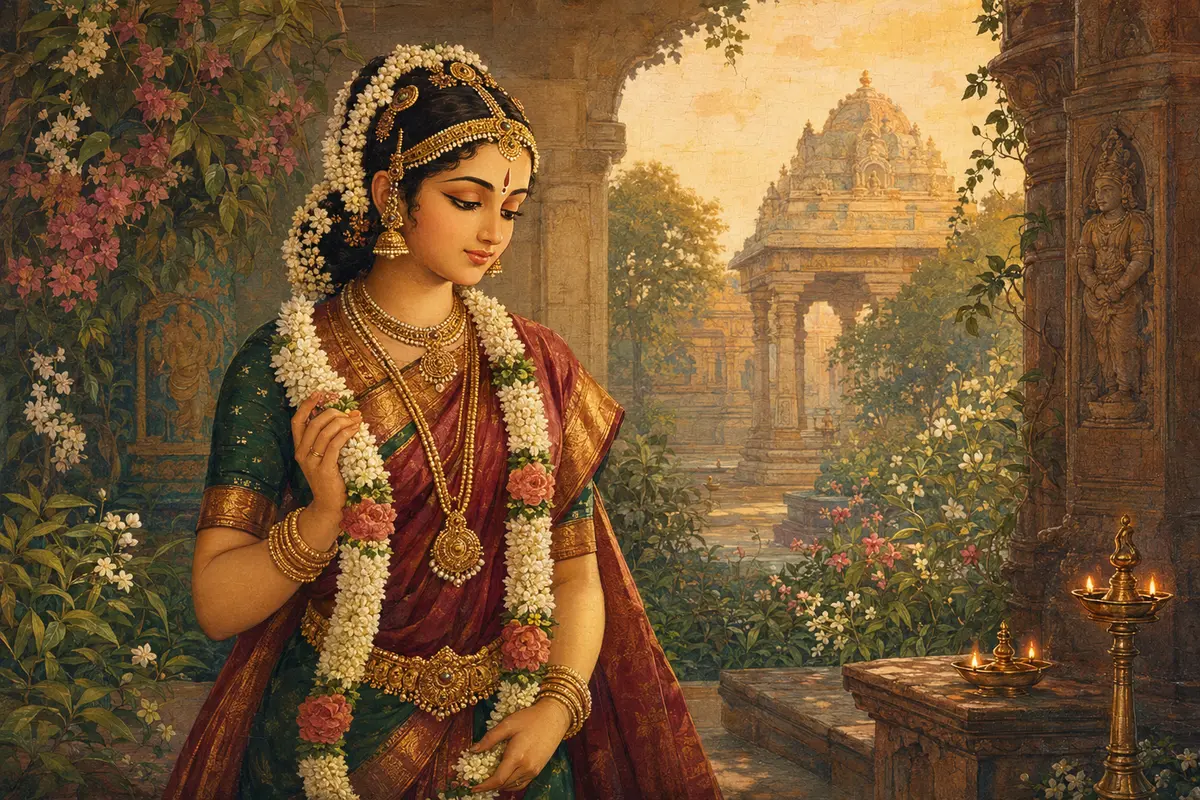
Andal wearing flower garlands in a temple garden
03

The poet-saint of Srivilliputtur

Andal: The Girl Beneath the Tulasi Plant and the Garland of Love

Andal’s life is remembered as a journey from a miraculous childhood to complete union with the divine through poetry, garlands, and unwavering love.

According to tradition, Vishnuchitta—later celebrated as Periyalvar—served Vishnu in Srivilliputtur and tended the temple garden. One day, while gathering tulasi leaves, he discovered a baby girl beneath the sacred plant. He received her as a divine blessing, raised her with love, and named her Kothai or Godhai. Devotees regard her as an incarnation of Bhumi Devi, the Earth Goddess.

Kothai grew up surrounded by temple songs, worship, and stories of Vishnu. Her devotion deepened until she saw herself as one of the cowherd girls of Vrindavan and Krishna as her only beloved. Each day, Periyalvar prepared a flower garland for the temple. Before it was offered, Kothai secretly wore it and looked at herself, wondering whether she was worthy to become the Lord’s bride.

When Periyalvar discovered this, he was distressed because an offering was expected to remain untouched. But Vishnu appeared in his dream and asked specifically for the garland Kothai had worn. Her love, rather than ritual perfection alone, had made the offering precious. She became known as Chudikodutha Sudarkodi—the radiant one who first wore and then offered the garland.

As Andal, she gave Tamil tradition two treasured works: the Thiruppavai, thirty hymns that call companions to awaken during Margazhi and seek Krishna together, and the Nachiyar Tirumozhi, which expresses her longing for divine marriage. Tradition tells that her devotion culminated at Srirangam, where she entered the presence of Lord Ranganatha and became one with him—the earthly poet becoming the divine bride.

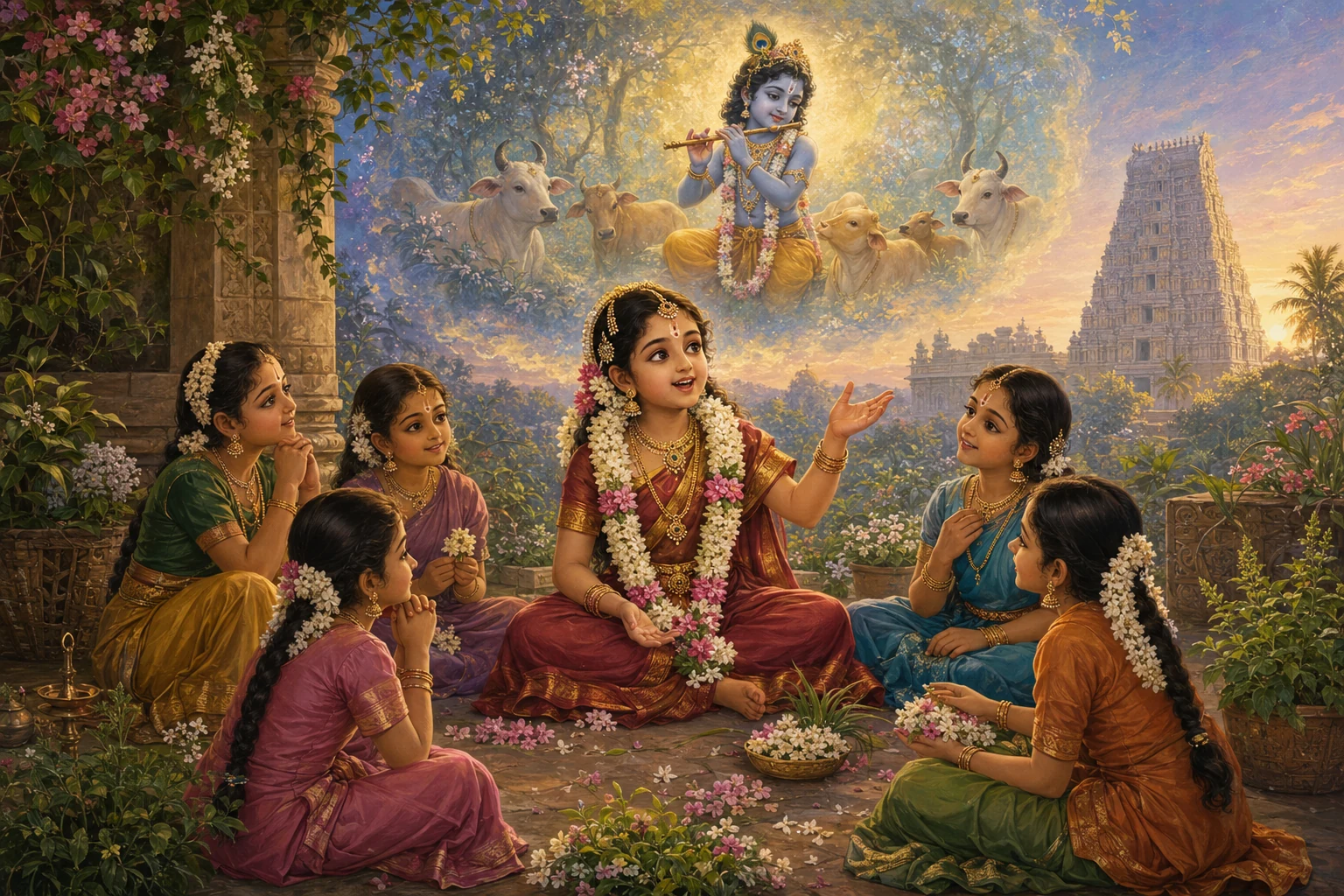
Andal sharing and imagining stories of Krishna with her friends in a temple garden
SourcesThe Goddess’s Divine Wedding with Lord Ranganathan — Om Spiritual Shop
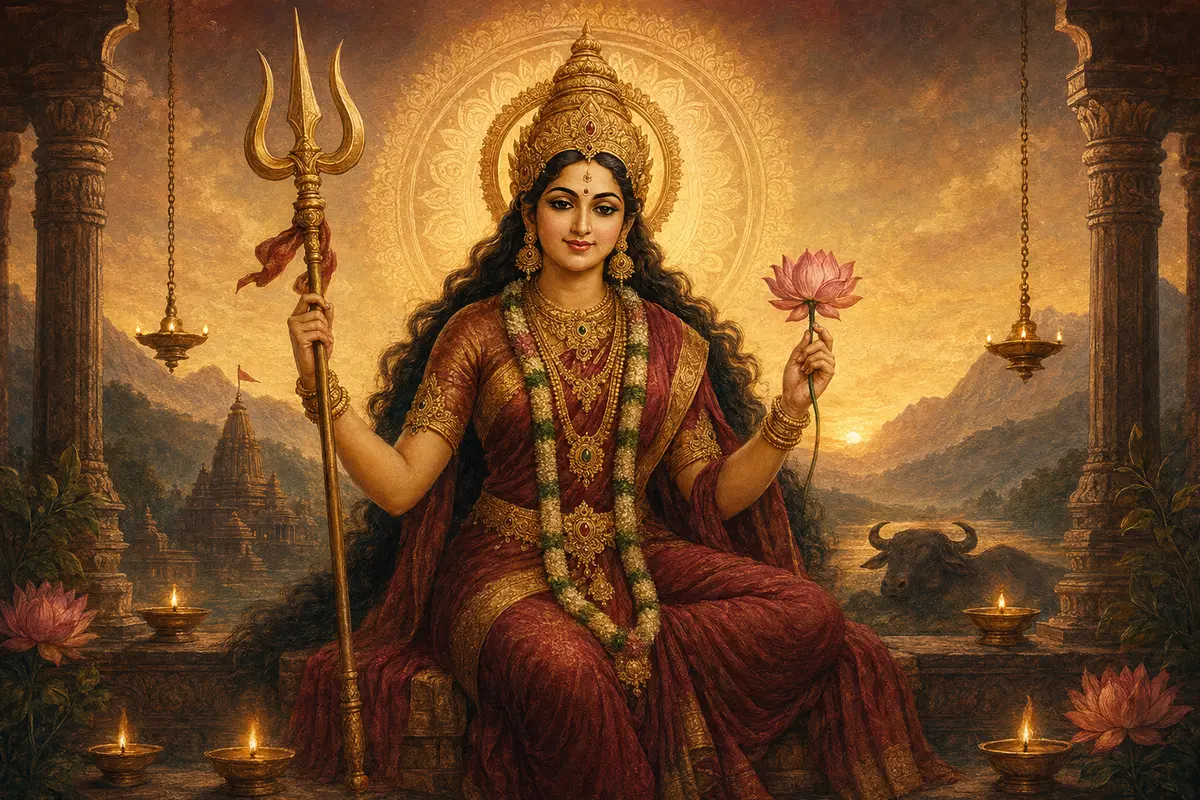
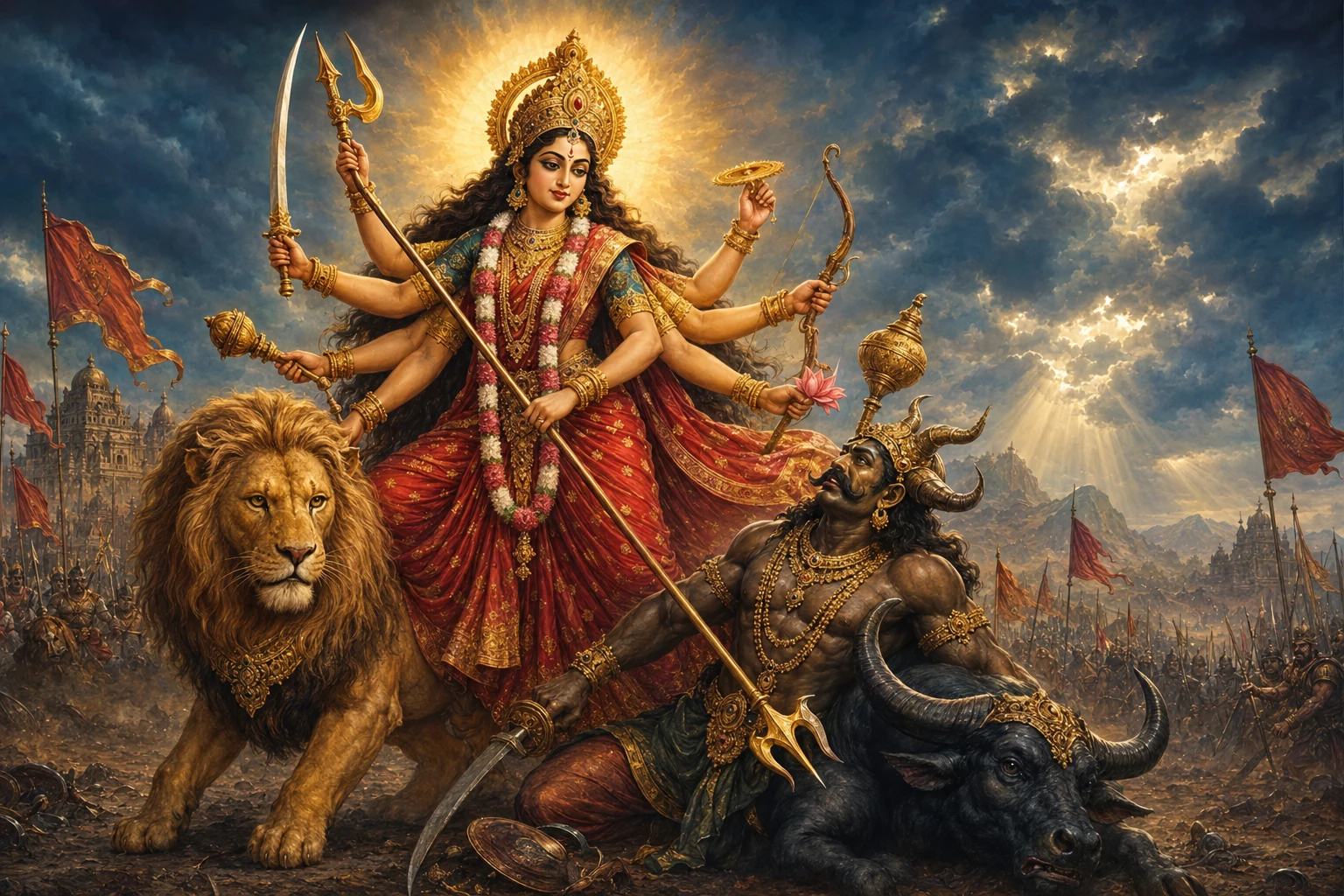
Goddess Durga holding a lotus and trident in radiant temple light
04

Nine nights of courage

Durga and Mahishasura: When Divine Strength Restored the World

Mahishasura believed no man could defeat him. His arrogance overlooked the power of the Goddess—and that became the opening through which balance was restored.

Mahishasura was a powerful, shape-shifting asura who gained a boon that made him nearly invincible: he could be killed only by a woman. Convinced that no woman could match his strength, he terrorized the worlds, defeated celestial powers, and disrupted moral order.

The divine energies united and manifested as Durga, a warrior Goddess carrying the combined strength of the devas. She entered battle with many arms bearing their gifts and weapons, including the trident that became one of her most recognizable symbols. Mahishasura attacked with his army and repeatedly changed form—buffalo, lion, elephant, and warrior—in an effort to overpower or confuse her.

The struggle continued for nine days. Each transformation revealed another face of his uncontrolled power, and each was met by Durga’s steadiness and skill. On the tenth day, the Goddess finally defeated Mahishasura. The victory is remembered not merely as the destruction of an enemy, but as the restoration of dharma: courage overcoming intimidation, clarity overcoming deception, and disciplined strength overcoming arrogance.

Durga is therefore both fierce protector and compassionate mother. Her power is not uncontrolled anger; it rises in defense of the world when every other force has failed. The story is celebrated through Navaratri’s nine nights and Vijayadashami, the victorious tenth day.

Goddess Durga defeating Mahishasura with her trident beside her lion
SourcesThe Story of Durga Maa and Mahishasura — Pandey Marble Arts
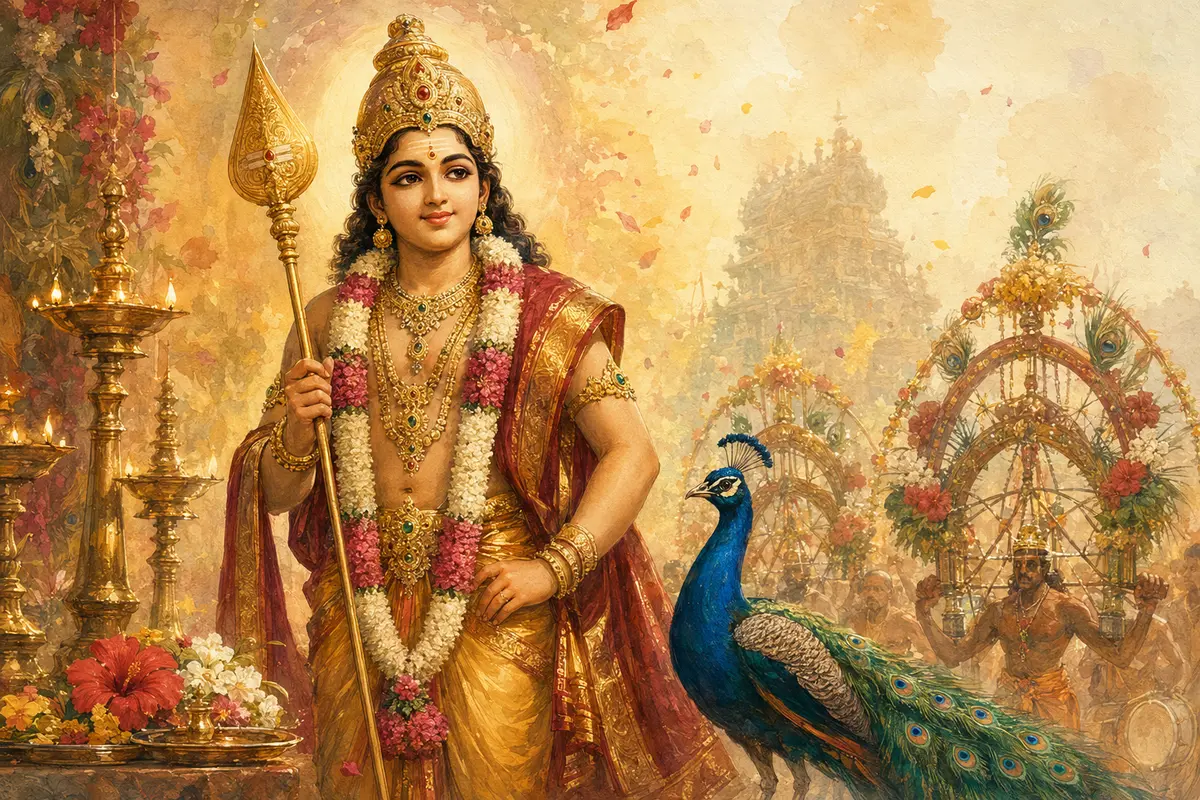
Lord Murugan with his vel and peacock amid festival light
05

The youthful ascetic of Palani

Murugan of Palani: Wisdom, Renunciation, and the Kavadi

At Palani, Murugan is worshipped not as a jeweled prince, but as Dandayudhapani—the youthful renunciate who stands with only a staff in his hand.

Palani is one of Murugan’s six sacred abodes, the Arupadai Veedu. The hill shrine presents him as Bala Dandayudhapani: a young ascetic holding a danda, or staff. The simple form conveys inner strength, discipline, and the wisdom to release attachment.

The kavadi tradition associated with Palani remembers Idumban, who was asked by the sage Agastya to carry two hills suspended from a pole across his shoulders. When he stopped at Palani, he found that one hill could no longer be lifted because Murugan stood upon it. A struggle followed, but Murugan later restored Idumban and blessed him as guardian of the hill.

Murugan declared that devotees who came bearing the kavadi with sincerity would receive his grace. What began as a physical burden became a symbol of prayer, gratitude, and surrender. Pilgrims still carry decorated kavadis toward Murugan’s shrines, turning effort into devotion and movement into worship.

The Palani image and the kavadi procession share the same lesson: spiritual strength is not measured by possessions or display. It appears in discipline, purpose, and the willingness to carry one’s offering with love.

SourcesDandayudhapani Temple, Palani — Astropuja
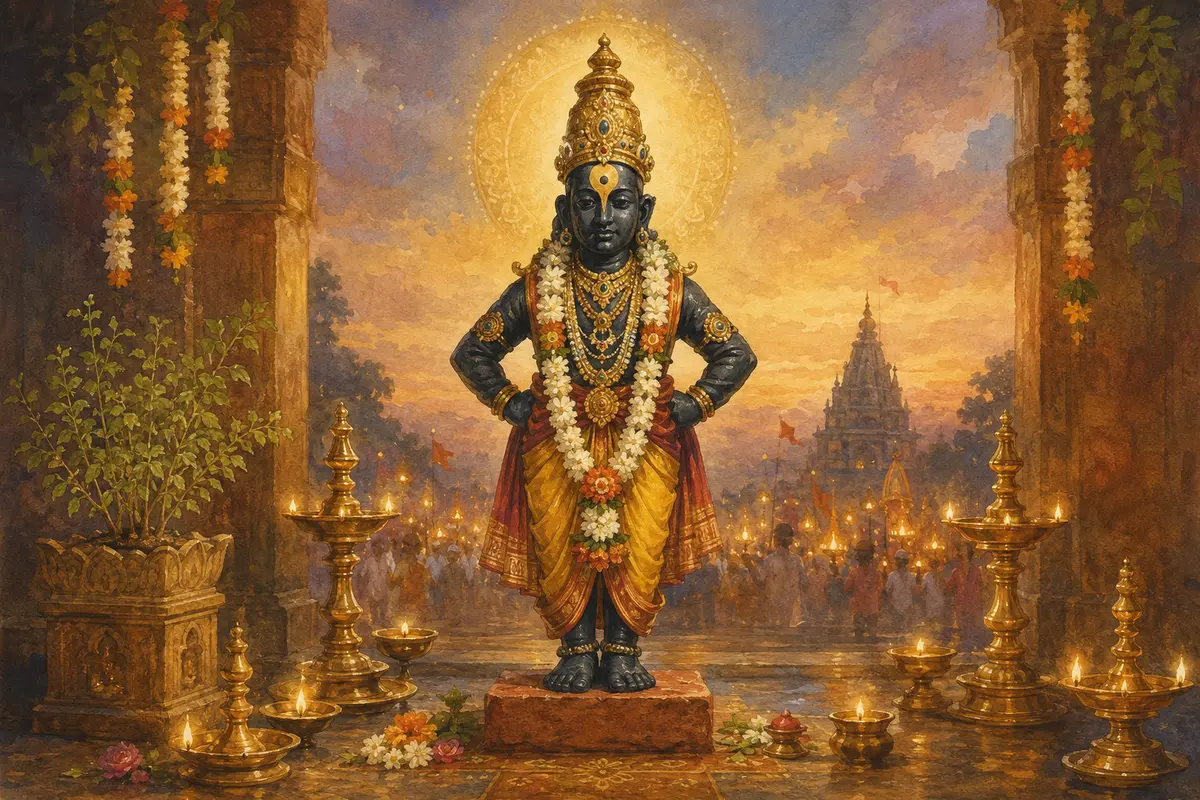
Lord Vitthala standing upon a brick amid lamps and devotees
06

Devotion in everyday work

Janabai and Vitthala: The God Who Helped With the Chores

For Sant Janabai, God was not distant from ordinary life. Vitthala was present at the grinding stone, beside the river, and in every humble household task.

Janabai arrived in Pandharpur as a young orphan and was taken into the household of Damasheti, father of the great devotee Namdev. She grew up in the family and spent her life as a maidservant, later becoming Namdev’s disciple. She affectionately called herself Nama’s Jani and expressed her devotion through abhangs—songs composed in the language of everyday life.

A large household meant endless work. Before flour mills, grain had to be ground by hand at dawn using a heavy stone. Tradition remembers Janabai singing Vitthala’s name while she worked—and Vitthala himself appearing to turn the grinding stone beside her. In her songs, he wore his yellow garment and asked her simply to watch and sing.

The Lord’s help did not end there. Janabai described Vitthala fetching water so her feet did not become wet, carrying refuse after she swept the courtyard, forming cow-dung cakes, and even tending her hair because she had no mother to care for her. She approached him not only as Lord, but as parent, sibling, companion, and intimate friend.

Her stories gave dignity to work that society overlooked and hope to those pushed to its margins. Janabai’s central teaching was beautifully simple: she could grind, sweep, carry water, and still remain continuously absorbed in the divine name. Nothing in daily life was too ordinary to become an offering, and no devotee was too humble for Vitthala’s companionship.

SourcesSant Janabai — VivekaVani

Ready for the performance?

Return to the dance guide

Explore all nine performances